That’s why patient lifts exist. Some people call them transfer lifts; some call them mechanical lift devices. It doesn’t really matter what you call them; they all do the same basic job: get a person from one place to another without anyone getting hurt in the process.
If you’ve ever helped someone from bed to chair by hand, you know the moment where your grip starts to slip, and you’re just hoping for the best. A patient transfer lift removes that guesswork. The motion is controlled, not sudden, which matters as much for the patient’s confidence as for the caregiver’s spine. There are several kinds, though: manual, electric, standing, and ceiling. We’ll break down what each one is and how it helps, so you can pick the right fit for your needs.
Manual Floor Lifts (Hydraulic Lifts)
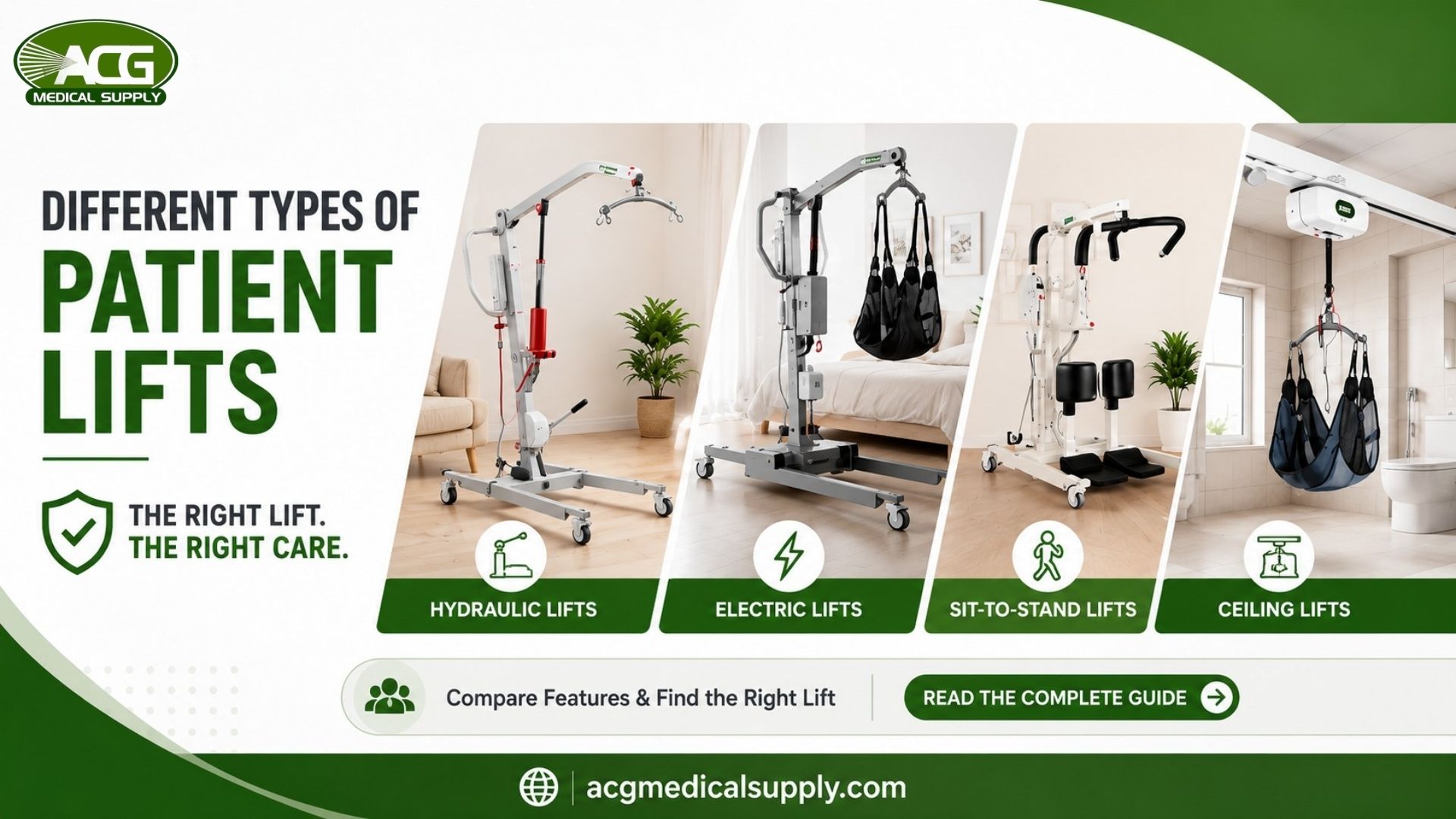
These are the classic Hydraulic Patient Lifts, sometimes called Hoyer Lifts after one of the original manufacturers. The name’s stuck around the way “Kleenex” means tissue now, even on lifts from other brands. They work off hand-pumped hydraulic pressure rather than electricity: a lever pushes fluid through the system, and the lifting arm inches up with each pump.
The frame rolls on four wheels with a wide base underneath for stability. A caregiver slides a sling under the patient, hooks it to the spreader bar, then works the handle or foot pedal until the patient clears the surface.
No battery or motor to worry about means these are cheaper up front, simple to maintain, and they’ll still work through a power outage. They’re lighter too, which is nice if you’re wheeling one from room to room all day.
The downside is the pumping itself. It’s not difficult per se, but it’s real effort, and it adds up over a heavier patient or several transfers in one day. The lift also rises in small increments rather than one continuous motion, so it’s not the smoothest ride; still, if you’re on a budget and only need occasional transfers, it’s a solid choice.
Electric Floor Lifts
Now for something a bit fancier: Electric Floor Lifts. These are battery-powered patient lifts that do the lifting at the push of a button. Instead of pumping, you get a remote; it’s usually a simple box with up/down buttons that tells the motor to raise or lower.
The biggest advantage is ease. No muscle power is required from the caregiver at lift-time. It’s nearly effortless. The motion is super smooth and continuous, so the patient doesn’t feel any jerks. If your caregiver has a weak back or if you do multiple transfers a day, an electric lift can be a blessing. It’s user-friendly, and most patients find it more comfortable, too.
The trade-off is cost and upkeep. Electric lifts run well beyond what a manual one costs, and the battery needs regular charging, which means remembering to plug it in and having a backup plan if the power’s out and the battery’s dead too. They’re also usually bulkier because of the extra hardware.
Standing Lifts or Sit-to-Stand Lifts
Next up are Standing Lifts, also called Sit-to-Stand Lifts. These lifts are a little different: they’re meant for patients who can bear some weight on their legs (at least partially); they are not really made for someone who can’t use their legs at all.
Instead of a full-body sling, the patient wears a torso-and-leg harness and pushes up, with help, from a seated position into standing, using the lift’s frame for support. Once they’re up, the caregiver wheels them a short distance, chair to chair, or over to a raised toilet seat.
This comes up a lot after surgery or with mild weakness, where keeping someone using their own muscles is part of the point. It’s usually lighter and cheaper than a full hydraulic or electric floor lift too.
The limitation is pretty obvious: it only works if the patient has some leg strength and balance to start with. It’s not a fit for someone who’s bedridden or can’t bear weight at all, and it’s a bit less stable overall since the person stays upright and partly self-supporting the whole time.
Ceiling Track Lifts
Overhead or Ceiling Lifts skip the floor entirely. A track mounts to the ceiling, and a motorized carriage rides along it, lowering a sling to lift the patient and then gliding along the rail to move them, bed to bathroom for instance, without a bulky base taking up floor space.
Since there’s no wheeled frame to steer, one caregiver can usually manage a transfer alone, and the higher-end systems can handle heavier weights than a typical floor lift.
The catch is installation. You’re modifying the ceiling structure, which costs money and isn’t something you take with you if you move. It’s not portable the way a floor lift is either; you’re limited to wherever the track runs. For someone who needs frequent help throughout the day in a home that isn’t changing anytime soon, it can make single-caregiver care actually workable.
Bariatric Lifts
“Bariatric” just means built for higher weight capacities, often 500 to 700-plus pounds depending on the model, compared to roughly 400 pounds or less for a standard lift. These come in manual, electric, and ceiling versions, just reinforced: wider frames, bigger wheels, sturdier slings, sometimes dual hydraulic pumps.
If a patient’s weight is near or over a standard lift’s rating, this isn’t really optional. A lift straining past its limit is a safety risk for the patient and the caregiver both. The trade-off is mostly space and cost. Bariatric lifts are wider and heavier, so it’s worth checking your doorway widths before buying one.
Bath and Pool Lifts
Bathing and swimming come with their own transfer problems, and there are lifts built specifically for water.
Bath Lifts are portable seats that sit inside the tub. The patient transfers onto the seat from outside the tub, and the lift lowers them into the water and back out, manually or with a small battery motor depending on the model.
Pool Lifts work similarly but for swimming pools, either bolted to the deck or fully portable. A common design swings the seat out over the water on an arm, lowers the person in, then swings back once they’re done.
Both usually have lower weight limits than floor or ceiling lifts, often in the 200 to 350 pound range, and most fold down for storage since they’re not left sitting in the water full time.
How to Choose the Right Lift
Picking a patient lift for home use requires a bit of measuring and a lot of practical thinking. You have to measure the widths of the bedroom and bathroom doorways. You have to look closely at the space under the bed. Floor models need at least a few inches of clearance to slide their metal legs under the mattress so the boom arm can reach the person properly.
Think about the primary caregiver too. A heavy-duty manual model might save a little money upfront, but if the person operating it is elderly or has a bad shoulder, an electric model is the only logical choice.
ACG Medical Supply carries various configurations precisely because no two homes are identical. Every family has a different daily routine. You want a tool that immediately reduces stress in the house. Not one that adds frustration because it is too hard to push over a rug. Take the time to evaluate the floor surfaces, the room sizes, and the physical strength of the people managing the daily transfers.
Quick Reference
| Type | Best For | Setup Requirement |
| Manual Floor | Budget daily transfers | Caregiver strength to operate the pump |
| Electric Floor | Smooth, frequent transfers | Outlet for battery charging |
| Sit-to-Stand | Patients with some leg strength | Ability to sit up and bear partial weight |
| Ceiling Track | Tight floor space | Ceiling structure that can support installation |
| Bath Lift | Bathtub transfers | Standard tub dimensions |
| Bariatric | High weight capacity | Wider doorways for the larger frame |
FAQs
A device that moves someone who can’t stand or walk unassisted without the caregiver lifting them by hand.
Manual uses a hand pump, whereas electric uses a battery motor and remote, so it’s smoother but pricier.
Match the lift to the patient’s weight and mobility first, then fit that to your space and budget.
“Hoyer” is just a brand name that became shorthand for manual hydraulic floor lifts in general.