Moving someone who cannot support their own weight is tough. It takes a massive physical toll on the body. A human spine just isn’t built to twist, lift, and shift a full-grown adult multiple times a day. Caregiver burnout is a very real thing, and physical exhaustion plays a huge role in it, so investing in a proper patient transfer lift takes that dangerous strain right out of the equation. These devices turn a stressful, physically demanding process into a safe, calm routine.
People hit a wall pretty quickly when trying to figure out the technical differences. The biggest choice always comes down to the power source. The whole debate of a hydraulic patient lift vs electric patient lift pops up immediately on every medical supply forum. The thing is, both machines do the same core job: they lift heavy weight so humans don’t have to. But how they actually go about that job is totally different.
What a Patient Transfer Lift Actually Does
A medical patient lift moves someone who can’t stand or walk unassisted between two points: bed to chair, chair to toilet, wheelchair to car seat. A sling wraps around the patient’s body and hooks onto the lift’s frame. The frame does the lifting. Nobody’s spine gets thrown out trying to half-carry an adult across a bedroom.
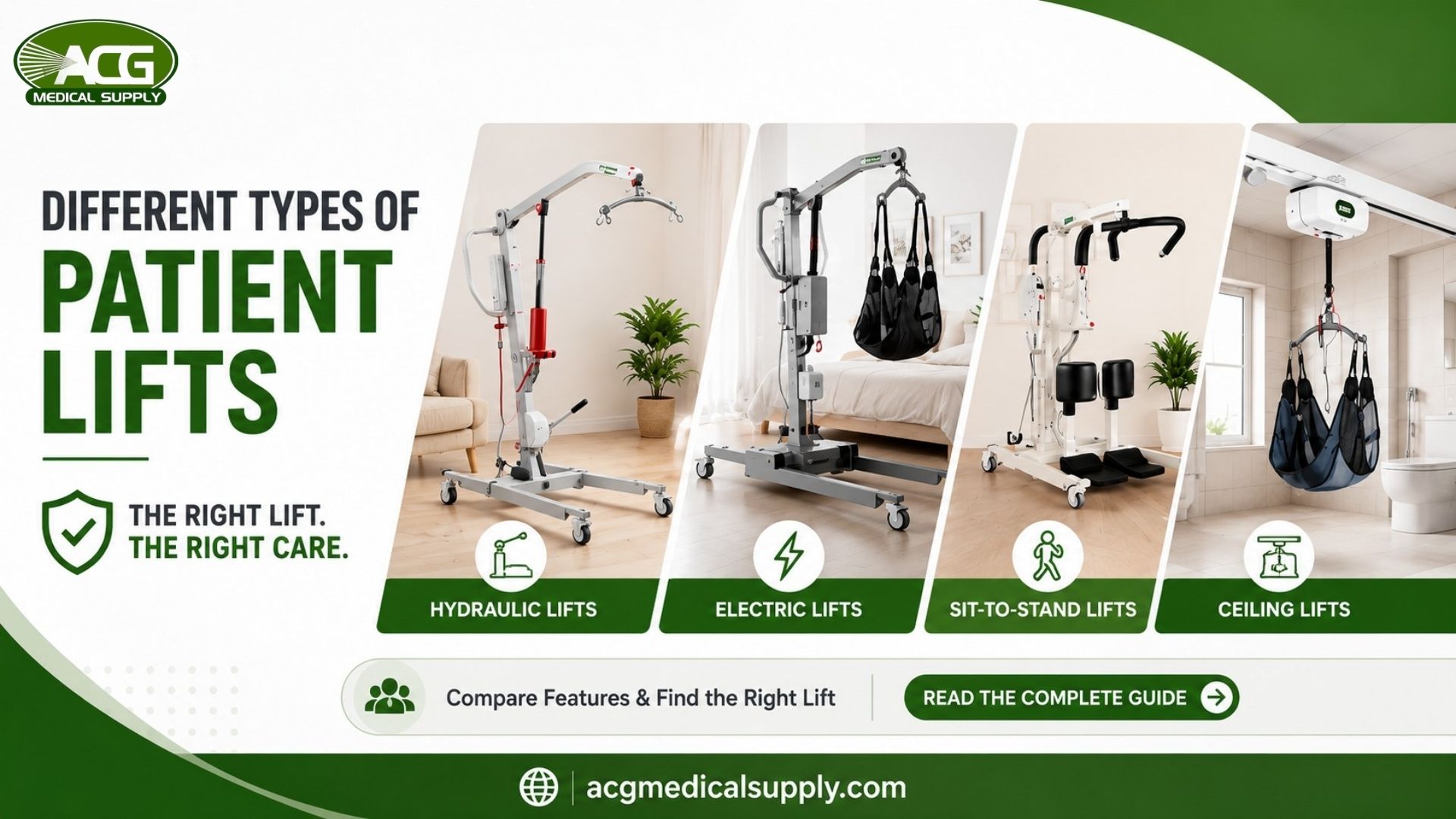
Every model on the market falls into one of two camps: pump-powered or battery-powered. That split is basically the whole conversation.
These lifts show up most in homes dealing with stroke recovery, advanced arthritis, ALS, or the general frailty that comes with age. Hospitals have used similar equipment for decades. Home caregivers are just catching up to the same idea, usually after one too many close calls trying to lift someone alone. Learning how to safely use patient lifts ensures those close calls don’t happen in the first place.
Hydraulic Patient Lift: The Pump-and-Lever Workhorse
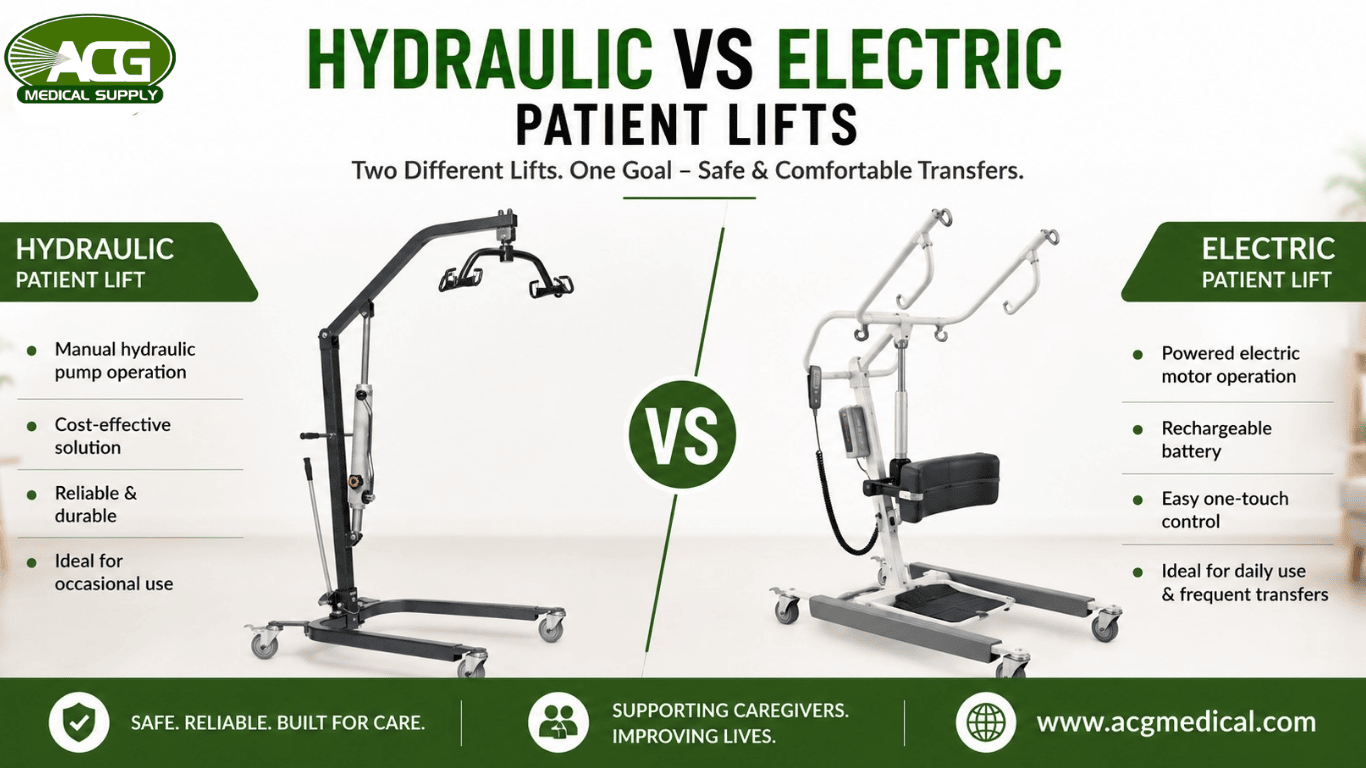
A hydraulic patient lift runs on a manual hand pump that pressurizes fluid inside a cylinder, and that pressure pushes the lift arm upward. No batteries. No motor. Just a lever and some hydraulic fluid doing the heavy lifting.
The Lumex 1031fp, sold through ACG Medical, is a good example of what this category looks like in practice. It’s built from heavy-gauge steel, uses a six-point spreader bar with 360-degree rotation, and the base adjusts with a foot pedal so a caregiver doesn’t have to bend awkwardly.
Hydraulic Patient Lift Advantage
Cost is one of the biggest reasons people choose a hydraulic patient lift. Manual models are generally more affordable than electric alternatives, often costing hundreds of dollars less. Hydraulic lifts also don’t rely on batteries or charging, so they’re always ready to use. With fewer moving parts and a pretty simple hydraulic system, maintenance and repairs are also easier when servicing is required.
Hydraulic Patient Lift Disadvantages
The main drawback is the physical effort involved. Every lift requires the caregiver to pump the handle repeatedly, which can become tiring when several transfers are needed throughout the day. The lifting motion is also less continuous than that of an electric model, as the arm rises in small increments rather than in one smooth movement. When a hydraulic patient lift is used for multiple daily transfers, the repeated pumping can quickly lead to caregiver fatigue.
Electric Patient Lift: Push a Button, Let the Motor Work
An electric patient lift swaps the hand pump for a rechargeable battery and a small motor. All you have to do is press a button on a handheld remote, and the lift arm rises or lowers on its own. No pumping is required; therefore, there’s no arm fatigue by dinnertime.
The Raizer II by Liftup, also carried by ACG Medical, is one example of this type of lift. It is designed to help lift a person safely from the floor after a fall. The lifting process can be operated using either the handheld remote or the control panel built into the seat.
Electric Patient Lift Advantages
Smoothness is the headline feature. The lift moves in one continuous motion, which feels less jarring for the patient and takes the physical strain off the caregiver almost entirely. That matters a great deal for caregivers managing solo transfers, dealing with their own joint pain, or simply working without backup most days. One button, and the machine does the rest.
Electric Patient Lift Disadvantages
Cost is the first hurdle, often two to four times the price of a comparable hydraulic model. They also rely on a rechargeable battery, so regular charging is essential to ensure the lift is ready when needed. In addition, some electric models are heavier because of the motor and battery system, making them a little less convenient to move between rooms.
Hydraulic Patient Lift vs Electric Patient Lift: A Side-by-Side Look
| Feature | Hydraulic Patient Lift | Electric Patient Lift |
| Power source | Manual hand pump | Budget-conscious homes, backup lifts |
| Typical price range | $800–$1,500 | $2,000–$5,500+ |
| Physical effort required | Moderate to high | Minimal |
| Motion smoothness | Stepped, slightly jerky | Continuous, steady |
| Charging needed | None | Yes, regularly |
| Weight and portability | Usually lighter | Often heavier |
| Best suited for | Budget-conscious homes, backup lifts | Frequent transfers, solo caregiver |
Best Hydraulic Patient Lift and Best Electric Patient Lift Picks
Budget usually settles this dilemma fast. The Lumex 1031fp tops most best hydraulic patient lift lists for one simple reason: it costs a few hundred dollars against a few thousand. Steel frame, foot-pedal base, nothing to charge. It won’t win any awards for a gentle ride, but it holds up.
The Raizer II costs a lot more, and it earns that price in one specific situation: someone’s just fallen and can’t get up on their own. One button, off the floor, no caregiver straining a back trying to help. That’s the whole argument for calling it one of the best electric patient lift picks ACG carries, even at nearly five times the price of the Lumex.
One More Thing: Slings Aren’t One-Size-Fits-All
People buy the lift and forget the sling matters just as much. It’s the part that actually touches the patient, and it has to match the spreader bar and the person’s own size and weight. ACG Medical carries full-body mesh slings rated up to 600 pounds, including a commode-cutout version for bathroom transfers, built to work with both hydraulic and electric lifts. Order the wrong size, and it’s going back in a box, assuming nobody tries to use it anyway.
Conclusion
Budget is important, so is the patient’s weight, how many transfers happen a day, and how much energy a caregiver actually has left by evening. This patient lift comparison doesn’t have one right answer, whatever a neighbor swears by.
Three or four transfers a day wears a caregiver down fast if pumping’s the only option, especially with a heavier patient. Electric usually wins there. Comfortable with the handle and watching the budget closely, hydraulic does the job just fine, no complaints. A decent patient lift for home use turns a risky, two-person transfer into a one-person job. That part isn’t up for debate. ACG Medical stocks both categories, along with the slings and spreader bars that go with them.
FAQs
No, they run on rechargeable batteries that need periodic charging.
Yes, though it takes more physical effort than an electric model.
Standard models typically support 400 to 600 pounds; bariatric versions handle more.
Often yes, as long as the spreader bar and weight rating match.